






Colloquium diei: “Cosmology with the Planck satellite”
 Sketched out in 1992, selected by ESA in 1996, and launched in 2009, the Planck satellite was shut off in 2013, after a measuring stage of the mission that collected over a trillion samples and exceeded all expectations. The Planck collaboration delivered a first set of cosmological data and results in March 21st 2013, and the full set in February 2015. Part of the data delivery is a “definitive” map of the anisotropies of the Cosmic Microwave Background (CMB), its angular power spectrum together with its full statistical characterisation, and the implications for cosmology. The 2015 delivery further includes pioneering polarisation maps, spectra, and their analyses.
The temperature anisotropy map displays minuscule variations as a function of the observing direction, of rms ~100microK, of the fossil radiation around its mean temperature of 2.725K. Other maps reveal the CMB polarisation patterns. These anisotropies are the imprint of the primordial fluctuations which initiated the growth of the large scale structures of the Universe, as transformed by their evolution, in particular during the first 370 000 years. These anisotropies can then be confronted with theoretical expectations.
I will described the results we obtained so far, both in terms of content of the universe and of characteristics of the primordial fluctuations which are found to match very well with expectations from an early inflationary phase in a Universe filled with cold dark matter and whose expansion recently started to accelerate.
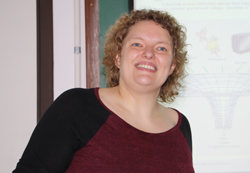 escrito pelo pesquisador Norman Gürlebeck, do Center of Applied Space Technology and Microgravity (ZARM), da University of Bremen (Alemanha).
 industry worldwide and in Brazil, and the role of physics in enabling the development of the industry. It will examine how electromagnetic, acoustic, nuclear and magnetic resonance technologies are used in the oil industry today and the potential for improving these methods through new sensor developments, signal processing techniques and theoretical modeling to help meet the challenge of developing the recently discovered Pre-salt oil fields offshore Brazil.
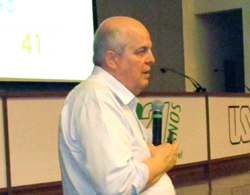 Neste colóquio, além de ter abordado os polímeros inovadores que deverão povoar o mundo na próxima década, Cassinelli destacou detalhes sobre o modelo de gestão da Inovação da Braskem, que envolve parcerias com o setor acadêmico e que inclui importante relação com a física.
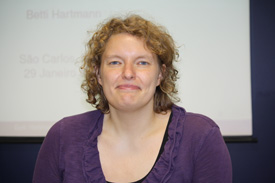 Em sua apresentação, que se inseriu na programação do High Energy Physics Seminars, a docente falou sobre os defeitos topológicos que aparecem em modelos de teoria de campo com quebra de simetria espontânea e distribuidor de vácuo não-trivial. Hartmann também discutiu as razões pelas quais essas cordas existem, suas propriedades gravitacionais, entre outros aspectos.
 No último mês de março, o Instituto de Física de São Carlos (IFSC/USP) recebeu Valentin Thibeaut e Mohammed Sabeur, dois alunos de graduação do Institut Universitaire de Technologie, da Aix Marseille Université (
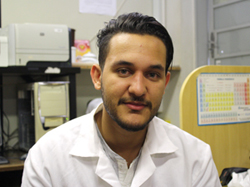 orientados pelo Prof. Dr. Valmor Roberto Mastelaro (IFSC/USP) e pela Profa. Bèatrice Trannoy (IUT-Marseille), têm trabalhado com a síntese e caracterização de amostras de materiais cerâmicos nanoestruturados. Mohammed Sabeur, de 20 anos, explica que decidiu vir ao Instituto de Física de São Carlos após a indicação de sua professora. Antes de vir para o IFSC, ouvi comentários bastante positivos a respeito do Instituto, principalmente, sobre a sua multidisciplinaridade, e foi aí que decidi.
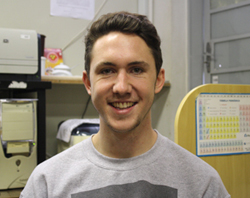 engenharia em uma escola francesa, mais particularmente na cidade de Lyon, ressalta o bom convívio que tem tido com seus colegas uspianos, com quem se reúne com certa frequência no final da tarde para praticarem esportes. A USP é um local bastante propício para fazer novas amizades e estudar, diz ele.
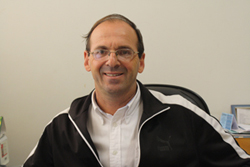 Para o Prof. Valmor Mastelaro, essa parceria é muito importante não apenas para esses estagiários, mas também para os próprios estudantes do Instituto de Física de São Carlos, que além de poderem comunicar com esses alunos, diariamente, aprendem as diferentes culturas trazidas por eles: Os nossos alunos também se beneficiam com a vinda desses estudantes estrangeiros, porque têm que falar em inglês, adquirindo, assim, novas experiências muito frutíferas.