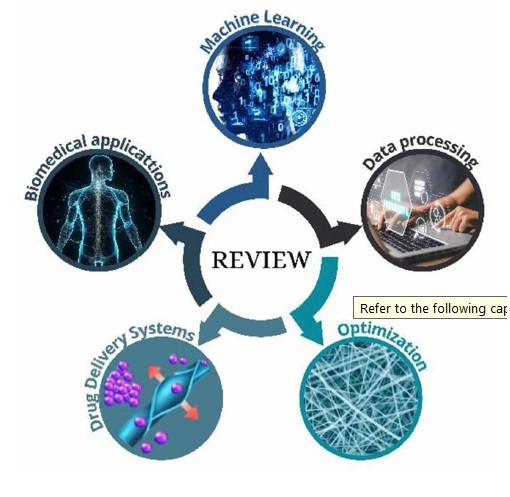
 Abstract: The use of machine learning (ML) is reshaping the design and optimization of nanofiber-based drug delivery systems (N-DDS). Electrospun nanofibers offer high surface area, tunable porosity, and versatile drug encapsulation strategies, making them attractive for controlled release applications in multiple therapeutic areas. However, the optimization of materials, fabrication conditions, encapsulation strategies, and release mechanisms is challenging due to the multitude of interdependent parameters. This review outlines how ML has been applied to accelerate N-DDS development, replacing traditional trial-and-error approaches with predictive and adaptive models. We first present a bibliometric landscape of the literature on nanofibers and DDS, highlighting the role of electrospinning. We then discuss recent applications of ML in polymer selection, electrospinning optimization, encapsulation strategies, and drug release kinetics. Special attention is given to case studies where ML models achieved high predictive accuracy in tailoring nanofiber morphology, encapsulation efficiency, and release profiles. We also elaborate upon the key challenges for clinical translation, including data quality, scalability, sustainability, and ethical concerns. By integrating ML and other artificial intelligence (AI) methods with nanofiber engineering, N-DDS can progress toward patient-specific, sustainable, and industrially scalable therapeutic platforms, opening new frontiers in precision medicine. Abstract: The use of machine learning (ML) is reshaping the design and optimization of nanofiber-based drug delivery systems (N-DDS). Electrospun nanofibers offer high surface area, tunable porosity, and versatile drug encapsulation strategies, making them attractive for controlled release applications in multiple therapeutic areas. However, the optimization of materials, fabrication conditions, encapsulation strategies, and release mechanisms is challenging due to the multitude of interdependent parameters. This review outlines how ML has been applied to accelerate N-DDS development, replacing traditional trial-and-error approaches with predictive and adaptive models. We first present a bibliometric landscape of the literature on nanofibers and DDS, highlighting the role of electrospinning. We then discuss recent applications of ML in polymer selection, electrospinning optimization, encapsulation strategies, and drug release kinetics. Special attention is given to case studies where ML models achieved high predictive accuracy in tailoring nanofiber morphology, encapsulation efficiency, and release profiles. We also elaborate upon the key challenges for clinical translation, including data quality, scalability, sustainability, and ethical concerns. By integrating ML and other artificial intelligence (AI) methods with nanofiber engineering, N-DDS can progress toward patient-specific, sustainable, and industrially scalable therapeutic platforms, opening new frontiers in precision medicine. |



 @article={003287695,author = {SOARES, Gabriella Onila do Nascimento; SANTI, Vitor Hugo Bridi Dei; SOARES, Andrey Coatrini; SOUSA, Diego Fernando Silva; SOUZA, Sarah Oliveira Lamas de; OLIVEIRA JUNIOR, Osvaldo Novais de.},title={Machine learning-enhanced nanofiber systems: a new frontier in controlled drug release},journal={Nanotechnology},note={v. 37, n. 5, p. 052001},year={2026}}