



Yeast membrane hydration is maintained under ethanol exposure.
GENOVESE, Darío Martín; SCARZELLO, Facundo L.; DOMINI, Georgina; CROSIO, Matías; MIRANDA, Paulo Barbeitas; WILKE, Natalia.
GENOVESE, Darío Martín; SCARZELLO, Facundo L.; DOMINI, Georgina; CROSIO, Matías; MIRANDA, Paulo Barbeitas; WILKE, Natalia.
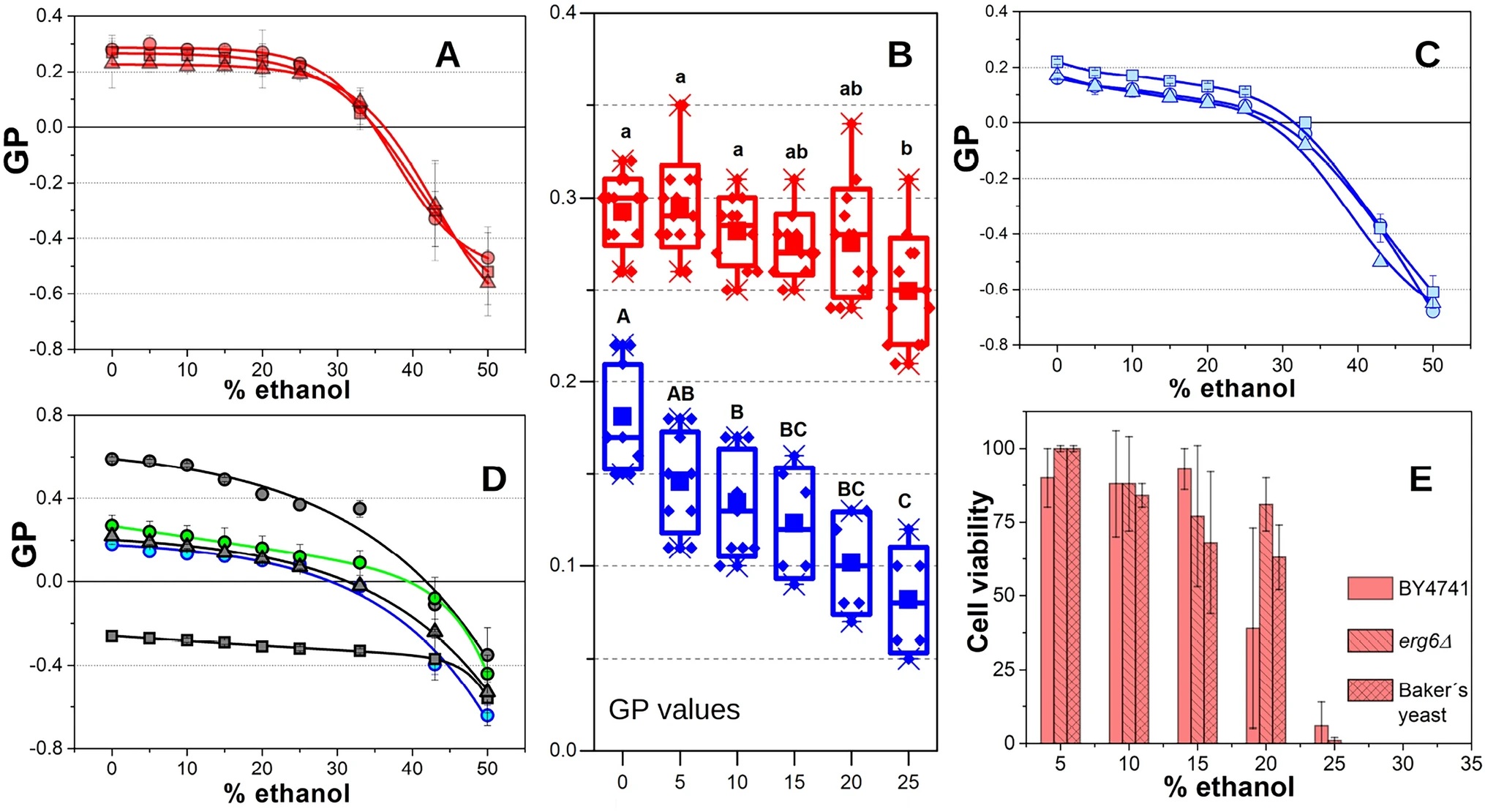 Abstract: Yeasts are able to tolerate different environmental conditions, including stress situations. Given their broad applications in the food industry, their ability to adapt to stressful conditions is an active area of research. Lipid composition of the yeast membrane is affected by environmental stress, and thus, the regulation of the membrane biophysical properties under such conditions may be a key point for yeast adaptation. Although Saccharomyces cerevisiae is highly tolerant to ethanol, its growth is inhibited when this alcohol accumulates in the medium. Therefore, we studied the effect of ethanol on yeast membranes using the fluorescent probe Laurdan, which is sensitive to water dipolar relaxation. Three strains were used: a laboratory strain of S. cerevisiae (BY4741), a mutant that lacks ergosterol (erg6 ), and a commercial baker?s yeast. At low ethanol levels, the emission signal of the probe remained constant for all strains. For ethanol proportions higher than 20% (v/v), at which cells are no longer viable, the signal changed abruptly, indicating an increase in solvent dipolar relaxation. We further studied BY4741 yeasts acclimated to high ethanol levels and found that water was more ordered in these membranes than in BY4741 grown in the absence of ethanol. We propose that water structure and membrane hydration are key for yeast viability in the presence of ethanol, and that studying the biophysical properties of membranes could be useful to identify yeast strains with a high tolerance to ethanol.
 @article={003277162,author = {GENOVESE, Darío Martín; SCARZELLO, Facundo L.; DOMINI, Georgina; CROSIO, Matías; MIRANDA, Paulo Barbeitas; WILKE, Natalia.},title={Yeast membrane hydration is maintained under ethanol exposure},journal={Journal of Membrane Biology},note={v. 258, n. 6, p. 447-460},year={2025}}