



Inhibitors of malaria parasite cyclic nucleotide phosphodiesterases block asexual blood-stage development and mosquito transmission.
GONZALEZ, Paula Josefina Gomez; GUIDO, Rafael Victorio Carvalho.
GONZALEZ, Paula Josefina Gomez; GUIDO, Rafael Victorio Carvalho.
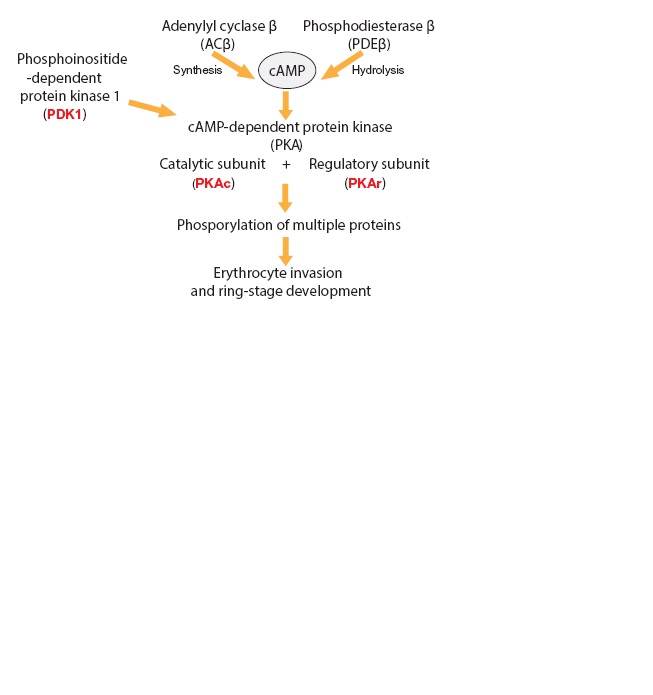 Abstract: Cyclic nucleotide-dependent phosphodiesterases (PDEs) play essential roles in regulating the malaria parasite life cycle, suggesting that they may be promising antimalarial drug targets. PDE inhibitors are used safely to treat a range of noninfectious human disorders. Here, we report three subseries of fast-acting and potent Plasmodium falciparum PDEß inhibitors that block asexual blood-stage parasite development and that are also active against human clinical isolates. Two of the inhibitor subseries also have potent transmission-blocking activity by targeting PDEs expressed during sexual parasite development. In vitro drug selection experiments generated parasites with moderately reduced susceptibility to the inhibitors. Whole-genome sequencing of these parasites detected no mutations in PDEß but rather mutations in downstream effectors: either the catalytic or regulatory subunits of cyclic adenosine monophosphate?dependent protein kinase (PKA) or in the 3-phosphoinositide-dependent protein kinase that is required for PKA activation. Several properties of these P. falciparum PDE inhibitor series make them attractive for further progression through the antimalarial drug discovery pipeline.
 @article={003226200,author = {GONZALEZ, Paula Josefina Gomez; GUIDO, Rafael Victorio Carvalho.},title={Inhibitors of malaria parasite cyclic nucleotide phosphodiesterases block asexual blood-stage development and mosquito transmission},journal={Science Advances},note={v. 10, n. 49, p. eadq1383-1-eadq1383-19 + supplementary materials},year={2024}}